What’s left for finance after AI?
How AI could reshape finance and open new markets.

Table of contents
Some people I've spoken to think the finance function won't exist in ten years.
I expect finance to change shape. Smaller teams could oversee more work, with a new kind of role at their center. As their systems become dependable, software could move from forecasting cash to making authorized payments.
For suppliers, that could open a market among companies that can't afford tailored finance today. A product could start with one recurring job and grow into more of the finance operation.
What companies need from finance
Finance helps a company understand its performance, meet its obligations and decide how to use its money. That work falls into five areas:
- Accounting and reporting: Records transactions and reports performance so the company can see what happened, what it owns and what it owes.
- Tax and statutory work: Calculates taxes, evaluates tax planning options and prepares the filings the company needs to meet its tax and statutory obligations.
- Financial planning and analysis (FP&A): Builds budgets and forecasts, explains differences between plans and results and helps managers decide how to run the business.
- Treasury: Tracks cash, manages liquidity and coordinates payment timing so the company has funds available where and when it needs them.
- Strategic finance: Evaluates funding options, investment plans and acquisitions to help the company decide how to raise money and where to commit capital.
Growth changes how owners, outside advisers and in-house teams share these responsibilities.
How growth changes the finance function
An owner often handles cash and planning with help from an outside accountant. As revenue grows, the company may add a controller, then FP&A and a CFO, followed by dedicated treasury and tax teams. Early hires often cover several of these jobs.
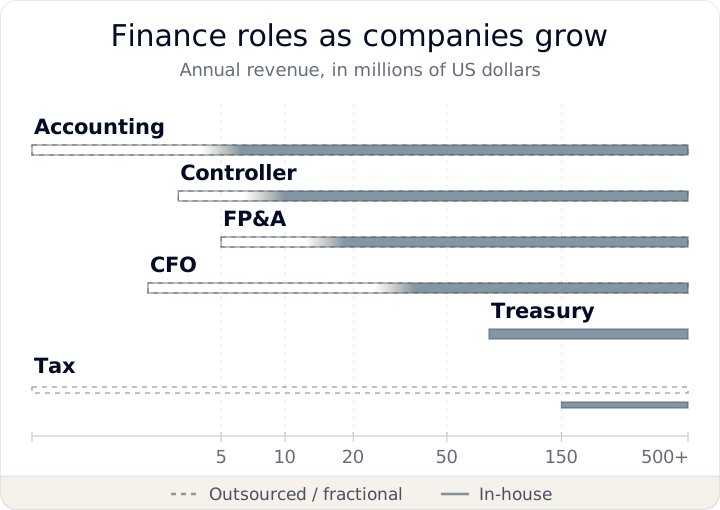
Revenue bands are approximate: the business model, systems and complexity shape the timing. Owners and executives continue to make strategic decisions. Outside tax advisers can work alongside an internal team.
What AI changes
We've spoken with many finance professionals about using AI in their work. Much of finance already has automation. AI could make it less expensive to adapt that automation to a company's data, rules and operating needs.
Accounting and reporting
Routine bookkeeping, payables, receivables and reconciliation are already largely automated in straightforward small businesses. Hiring an accountant is often driven by the need to prepare and check taxes.
The harder work involves company-specific accruals, revenue recognition, consolidation and intercompany transactions across sources, entities and currencies. ERP systems can handle this, but adapting them to each company's rules is expensive.
AI could turn a professional's explanations and worked examples into rules, mappings and procedures. Once the professional validated the setup, agents could run recurring work automatically. The professional could revise the rules as the business changes and handle exceptions.
Tax and statutory work
For many small businesses, preparing taxes is a main reason to hire an accountant. Owners are buying expert review and professional sign-off, as well as a completed filing. As we argued in Signature economy, someone needs to understand how the numbers were made before standing behind them.
Tax services already combine software automation with human review. AI could assemble company-specific facts and draft calculations linked to supporting records and assumptions, reducing preparation time and making the work easier to inspect. Qualified professionals would still resolve uncertain treatments and judge whether the result is ready.
FP&A
Budgets and forecasts need to reflect each company's business model and the economics of its industry. Even familiar measures can have company-specific definitions and calculations.
The owner often does this work initially, then delegates it to finance as preparing models and crunching numbers takes more time. AI could prepare models and run the calculations, letting the owner or CFO explore questions more directly.
Someone still needs to understand and supply the business logic and interpret the results. Depending on the company's size and complexity, that could be the owner, CFO or a dedicated specialist. Outside analysts can support the work, but outsourcing calculations doesn't by itself transfer operating knowledge or responsibility for decisions.
Treasury
Cash visibility, reconciliation and payment scheduling already have substantial automation. AI could make it less expensive to connect these tools and implement a company's liquidity and currency rules.
A useful cash view must account for money committed to payroll, contracts and investment plans, rather than treating the bank balance as available to spend. That context supports payment timing and funding decisions while the company retains control of its money.
The owner or CFO covers this work in smaller businesses; dedicated treasury staff become useful at sufficient scale.
Human oversight remains
AI doesn't remove applicable audit requirements or rules on approvals and signatures.
- In the UK, the board approves annual accounts and a director signs the balance sheet on its behalf.
- In the US, covered annual and quarterly SEC reports, including Forms 10-K and 10-Q, require signed certifications from principal executive and financial officers or people performing those roles. They cannot delegate those signatures.
As an internal control principle, segregation of duties separates execution from approval and review. An agent should not be the only check on its own work.
People must still supervise the work, understand how outputs were produced and approve or sign where their roles require it.
Lessons from the shift to cloud computing
During the cloud boom 10 to 15 years ago, I remember system administrators worrying about their future. If everything moved to the cloud, would their profession disappear?
When I joined Yandex Mail, our administrators looked after hundreds of servers. Moving to an internal cloud changed their role.
- Before 10 administrators Operating the mail infrastructure
- After 2 DevOps engineers Automating mail operations
What could this story teach us?
I expect finance to follow a similar pattern, with AI taking on more recurring work.
- A FinOps role could emerge. I prefer the name FinOps for a specialist who applies accounting or FP&A expertise to build, configure and supervise automated financial workflows and their business logic. Think of it as a finance counterpart to DevOps. a16z describes a related finance engineer role.
- The strongest opportunity is in midsize and larger companies. My rough starting point is $20 million to $25 million USD in annual revenue, depending on workload and complexity. Cloud computing removed substantial hardware and administration costs. But microbusinesses may already pay trusted accountants modest fees, leaving little to save. In my experience, low fees and infrequent buying can make customer acquisition hard. Midsize and larger companies have more recurring work and company-specific processes to automate.
How cloud ERP reshaped the market
Cloud ERP and related finance software grew around different buying needs:
- Outgrowing the existing software. Organic growth can push a company beyond basic accounting tools. NetSuite, Sage Intacct, Microsoft Dynamics and Acumatica offer a more capable financial core or ERP.
- Consolidating after an acquisition. A group may need to combine results while retaining local ledgers. OneStream, CCH Tagetik, Lucanet and Oracle EPM serve this consolidation and reporting need.
Both needs supported substantial software businesses.
What could this story teach us?
Start with what triggers the transition. The same cloud or AI technology can serve both needs, but different buying situations call for different products.
Five years ahead: the rise of FinOps platforms
In 5 years, agents could let smaller finance teams oversee more work. A hypothetical multi-country fintech with three accountants, an FP&A analyst and a CFO could operate with a CFO and a FinOps engineer, supported by outside tax advisers.
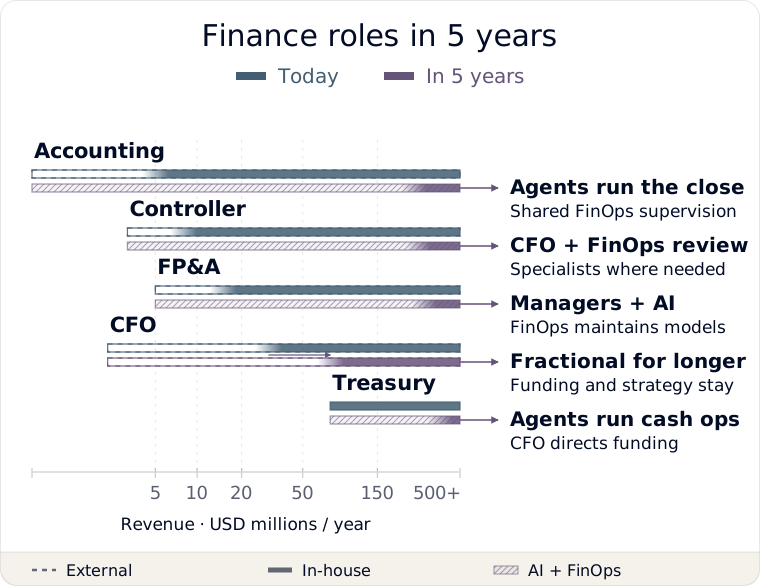
FinOps would keep automated finance running. I use the name for a finance specialist who connects systems, translates accounting policies into workflows, maintains models and investigates exceptions. It combines finance expertise with building and supervising automation, much like the finance engineer role described by a16z.
Separate accounting, controller and treasury execution teams could shrink into shared FinOps supervision. Agents would run the close, consolidation and agreed cash procedures. Managers would do more FP&A directly with AI. The CFO would retain strategic finance, funding and liquidity decisions. Tax specialists would review AI-prepared calculations and filings, with less preparation work and continued professional sign-off. Complex companies could still need dedicated specialists.
FinOps platform and two customer segments
Both segments need much the same agents, data connections, configurable rules and review tools. The main difference is who operates them:
- Fractional CFOs and accounting firms work across clients. The platform could let them serve more companies and support them longer as they grow.
- In-house finance teams work across their company's departments and entities. The same platform could automate more of their company-specific processes.
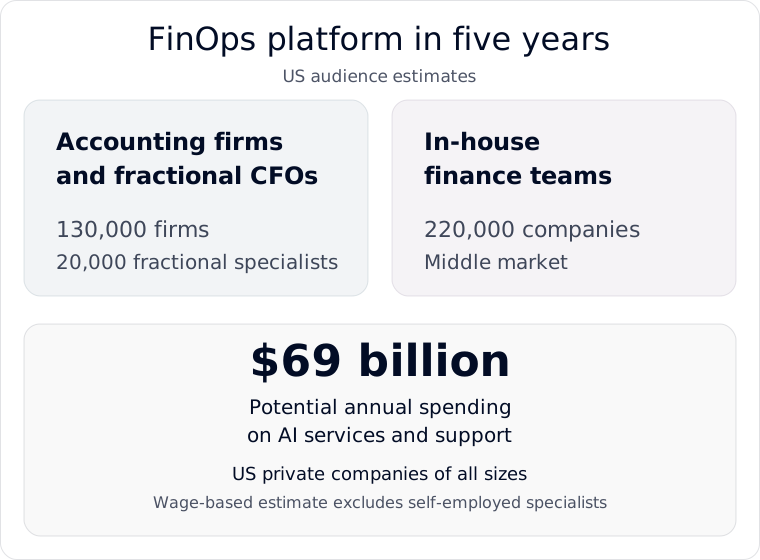
We assume 28% more finance work in five years. Adoption covers 90% of future work. Within that share, AI automates 50% to 95% depending on the role. Services including setup and support cost 20% of automated work’s wage value. That implies about $69 billion in annual spending across US private companies of all sizes.
Ten years ahead: what those foundations enable
Agentic payments for businesses
In the five-year scenario, a CFO and FinOps specialist oversee accounting, controller and treasury agents. Years of reliable operation would give those agents company context and earn trust.
They would know contracts, budgets and committed cash. They could coordinate checks on delivery, documents and timing then execute business payments automatically. Stablecoins on blockchains could carry the money while smart contracts execute transfers under agreed rules, providing infrastructure for agentic payments.
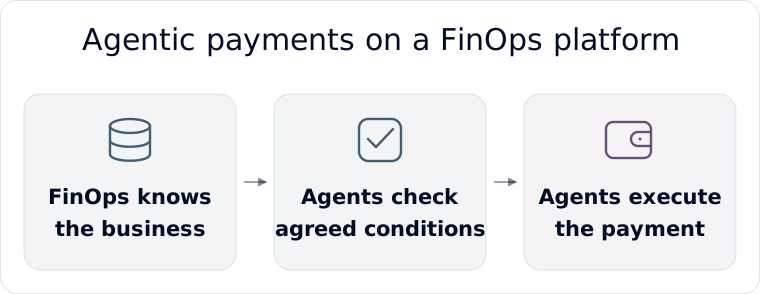
In the same fintech, the CFO and FinOps roles could combine into one person supervising automated finance. FP&A judgment and strategic finance would remain management responsibilities.
Outsourcing the CFO role
The five-year outsourcing story starts with a growing company already using external accountants or a fractional CFO. AI lets it keep that arrangement longer before hiring a full-time CFO.
By year ten, automation could let an established company outsource its in-house CFO role. It would still need human judgment and sign-off but no longer a full-time CFO. An AI-plus-human service could provide a CFO shared across clients.
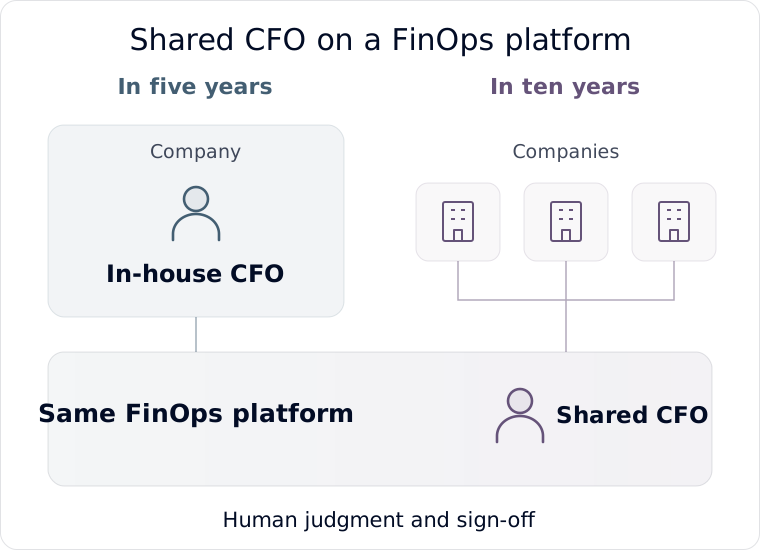
I expect the same FinOps platform already running the company's finances to be best placed to provide that service. It has the data, understands the processes and has earned the company's trust. That gives it an advantage over a traditional accounting firm.
Affordable enterprise-level personalization
AI could automate both financial work and the setup needed to tailor software to a company. Consultants and forward-deployed engineers do much of this manually: studying company data, mapping sources and configuring workflows around business rules. AI could take on much of that work through questions and worked examples, with users supplying business logic and reviewing results.
Excel persists because each business calculates differently. One shared platform with reusable, editable workflows could preserve that flexibility while making personalization faster and less expensive.
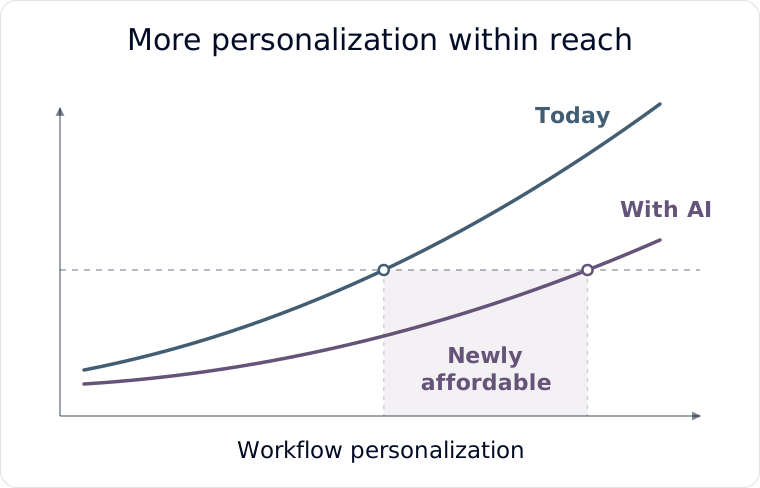
Expensive bespoke setup is one reason these products often need enterprise sales: discovery calls, demos and negotiations before implementation begins. Buyers need confidence that the product will fit before committing to the cost.
If users can get useful results from more complex workflows through self-service setup, the buying experience can change. A finance team could discover the product through search or a community, start a trial and configure it for its business. That opens the door to consumer-style SaaS distribution. Suppliers could spend less on both sales and implementation, bringing enterprise-level personalization within reach of more companies.
What a FinOps platform could look like
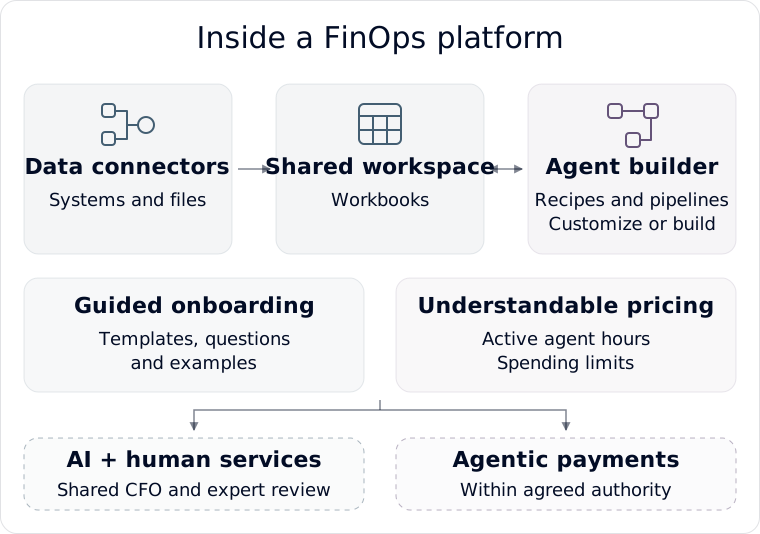
The accounting, FP&A and treasury agents described above need connected data and workflows that fit each business. I imagine one FinOps platform with five parts:
- Data connectors. One place to connect the company’s existing systems, files and spreadsheets so people and agents can work with their data.
- A shared workspace. Workbooks would hold the company’s data, models and calculations. People and agents could reshape both the workbooks and the procedures that use them: a fluid system of action.
- An agent builder and workflow library. Teams could build and run agents with a self-service library of ready-made recipes and pipelines for accounting, consolidation, FP&A and treasury. They could reuse a template, customize it or build their own pipeline.
- Guided onboarding. Teams would start by choosing a template. More advanced onboarding could use an agent to study connected data, suggest a workflow and ask questions about the company. People would supply business knowledge through answers and examples, then review the setup, as described in Welcome aboard, agent.
- Understandable, affordable pricing. The aim is enterprise-level personalization at prices smaller businesses can afford. Teams also need to budget for agent work. The pace is the price proposes a published rate per active agent hour at a defined working pace, with visible usage and spending limits.
By year ten, the same platform could offer AI-plus-human finance services such as shared CFO oversight. It could also execute agentic payments within agreed authority. Both would build on the context and trust earned through recurring finance work.
Where the transition begins
The starting point is a buying trigger. The cloud ERP story gives us two: outgrowing existing software and needing consolidation after an acquisition.
We estimate that each year in the US, 8,000 groups acquire businesses, while 6,000 companies cross $25 million in annual revenue through organic growth without acquisitions that year. That revenue threshold is a useful marker of greater financial-system complexity.
I would focus on consolidation for CFOs and finance teams in midsize multi-entity groups, including private equity-backed roll-ups. An acquisition creates an immediate need to combine results from existing systems, align accounting treatments and reconcile intercompany transactions.
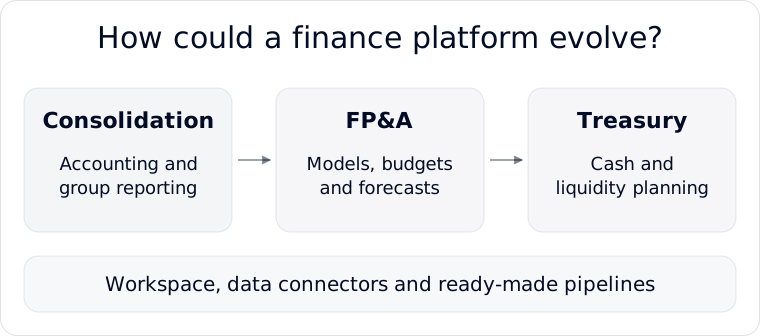
Start with an AI-based consolidation and accounting workspace. Its foundations are workbooks, data connectors and ready-made prompts and pipelines. The hard product work is turning finance expertise into processes teams can put to use. Users should be able to run them across existing systems and adapt their mappings, rules, calculations and reports.
Higgsfield’s creative templates illustrate the approach: users choose a ready-made format and supply their own material. I would bring that useful starting point to finance, with workflows people can inspect and adapt.
Once consolidation works reliably, the same workspace could grow into management reporting, FP&A and business forecasting. Teams could add ready-made workflows for variance analysis, budgets and scenarios. Those models and forecasts could then support treasury workflows for cash and liquidity planning.
Finance changes shape
The finance function remains, but AI changes who does the work. Smaller teams with FinOps specialists could oversee more of it, while people retain business judgment, accountability and sign-off.
For suppliers, affordable shared platforms that adapt to each business could expand the market for tailored finance, serving in-house teams and outside professionals. Consolidation offers a starting point for earning that broader role.